

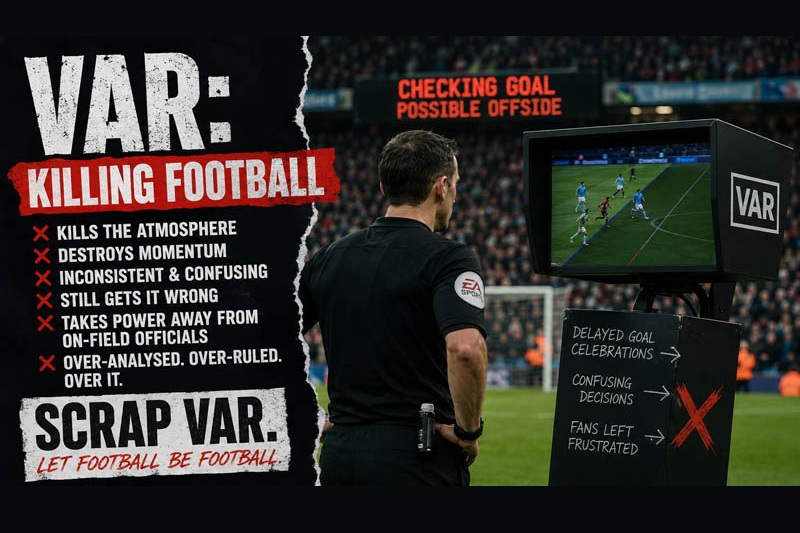
VAR Is Killing Football — And It’s Time To Scrap It Completely
There was a time when football felt human. Referees made decisions in real time, fans reacted instantly, and the game flowed with emotion, spontaneity and chaos. Sometimes officials got things wrong. That was part of football. You argued about it in the pub, ranted about it on the train home, and then moved on.
Now? Every goal comes with a waiting period. Every celebration is interrupted by the possibility that someone in a dark room 200 miles away is drawing lines on a screen. Football has become less about instinct and drama and more about forensic analysis.
VAR was introduced to “eliminate clear and obvious errors.” Instead, it has created confusion, inconsistency and endless controversy. It hasn’t improved football — it has drained the life out of it.
The worst part is that referees no longer feel like referees. They feel like on-field assistants waiting for instructions from Stockley Park. You can see the hesitation now. Officials delay decisions because they know VAR will bail them out. Linesmen keep flags down even when offsides are obvious because the technology might sort it later. Referees are no longer officiating with authority; they’re officiating with fear.
And despite all the technology, the mistakes are still happening.
This season alone has produced another mountain of baffling VAR moments. The Premier League’s own Key Match Incidents panel admitted that VAR errors have actually increased again, with multiple missed interventions and incorrect overturns already logged this season.
That alone should end the debate. If a system designed to eliminate mistakes is still producing this many mistakes nearly a decade later, then the system is fundamentally flawed.
The recent Arsenal vs West Ham controversy perfectly summed up the problem. Callum Wilson thought he’d scored a dramatic late equaliser, only for fans to stand around for over two minutes while VAR examined every possible angle before eventually disallowing the goal for a supposed foul on David Raya.
Even when decisions are technically “correct,” they still feel wrong. Football is an emotional sport, not a courtroom. Nobody inside that stadium wanted a three-minute legal review. They wanted football.
And consistency? Forget it.
One week minimal contact is considered “part of the game.” The next week identical contact is deemed enough to overturn a result. Jarrod Bowen openly questioned the consistency of VAR after the Arsenal incident, and he’s absolutely right. The standards shift every weekend depending on who is in the VAR booth.
Fans are constantly told to trust the process, yet nobody seems to understand the process anymore.
Handball decisions are another disaster entirely. The laws already confuse supporters, players and pundits, but VAR has somehow made things even worse. Slow-motion replays turn natural movement into “unnatural positions.” Incidents nobody noticed live suddenly become game-defining controversies after officials freeze-frame them from impossible angles. UEFA itself has had to repeatedly publish technical explanations for VAR interventions because supporters genuinely cannot understand why decisions are being made.
That’s the clearest sign something has gone badly wrong. If football needs legal-style explanations after every major incident, then the sport is no longer functioning naturally.
The obsession with microscopic offsides might be the most ridiculous aspect of all. Fans now celebrate goals while simultaneously glancing nervously toward the assistant referee. The joy has been replaced by anxiety.
Nobody fell in love with football because they wanted to see a striker penalised for their shoulder being two millimetres ahead after a three-minute calibration process.
And while VAR defenders constantly argue that “more correct decisions” justify the disruption, football was never meant to be mathematically perfect. Refereeing has always involved interpretation, personality and instinct. That human element mattered.
Some of the greatest moments in football history involved controversy. Debates lasted decades because the game was emotional and imperfect. VAR has attempted to sterilise football but somehow created even more arguments than before.
Worse still, the delays are ruining the atmosphere inside stadiums. A last-minute winner should create instant chaos. Instead, fans pause mid-celebration waiting for confirmation. That split-second uncertainty kills emotion. Football should not feel like waiting for exam results.
Even managers and former players who once supported VAR are losing patience. Criticism continues to grow across the Premier League and Scottish football after several recent controversies, including the uproar surrounding Celtic’s highly disputed penalty decision against Motherwell.
The reality is simple: VAR has changed the culture of football for the worse.
Referees used to command games. Now they point at their ears and wait.
Fans used to celebrate goals instinctively. Now they wait for graphics and line checks.
Players used to accept some decisions and get on with it. Now they surround referees demanding reviews after every challenge because they know the system invites constant re-examination.
The game feels slower, colder and more artificial.
Of course referees made mistakes before VAR. They always will. But football survived over a century without needing endless replay reviews and semi-automated geometry lessons. The occasional bad decision was frustrating, but it was still part of the same shared experience.
What football has now is worse: constant interruptions, endless uncertainty and a system that still gets things wrong anyway.
VAR promised clarity. Instead it has produced confusion.
It promised fairness. Instead it has created fresh controversy every single week.
Most importantly, it has stripped away the spontaneity that made football special in the first place.
The solution is no longer improving VAR.
The solution is scrapping it completely.